Showing posts with label Zebra Mallow. Show all posts

Wednesday, May 15, 2013

May 15th Garden Blogger's Bloom Day

It's been a while since I updated the strolling garden blog but now that things are green and starting to bloom I hope to update more regularly. The rain situation is still dire out here in West Texas. Rain is hit and miss here and the Lubbock area has not had even 3 inches since January. Cotton farmers have delayed their plantings in the hopes that May rains would occur but so far we've only mostly had a few sprinkles with little measurable rain. And the temperatures are suppose to hit the high 90s before the end of the week. Not good news. We just need a good, long soaking rain to penetrate the ground.
All is not bad news though. The garden is green, vibrant and blooming this month. It's easy to forget we're in year three of severe drought when wandering around in my back garden. The fence repairman made my day when he described my garden as "zen" as he walked around checking out the plants. And I didn't even prompt him. Blooming abvoe is snapdragons, dianthus, pincushion flower, and and purple salvia. The irises, hollyhocks, shasta daisy, and rose blooms are still to come. The wonderful thing about this whole grouping is that it is all perennial to my garden. Didn't have to plant one thing here this year as it all came back from last year.
Close up of the angel statue and rose bush planted in honor of Basil, my sweet tabby cat who passed away. If you want a very robust, striking plant that will keep multiplying I recommend this white saliva plant. I had three originally and have dug up seedlings to put all over the garden. Great as a background filler plant. It does spread out though, so give it some room.
This pretty, small (not even 2 ft. tall) iris bloomed unexpectedly this past weekend. It's the first time in 5 years it has bloomed since I planted it and I adore the color. Softer colors such as pastels and particularly blue-purples stand up to the intense sunlight and heat of West Texas better it seems. I have probably 100 irises scattered around my small suburban property but only about 20 percent ever bloom each year. I must be planting them too deep, or rather the dirt shifts over the bulbs due to dust storms and watering.
Neepeta Walker's Low is a must for the small garden. Blooms for months, the blue colored flowers are like a soft blue cloud in a flower bed, and the bees love it. I'm afraid of bees, and especially wasps, and yet I want to encourage the bees to come into the garden to pollinate the plants and the fruit trees I've planted this spring.
Been dividing the pincushion plants and spreading them around the garden. Awesome plant and I like how their blue heads bob and sway in the wind, which is something we never seem to lack out on the open plains here. The larkspur has reseeded everywhere in the grass and I've been slowly removing it by hand. Will have to get the lawnmower to finish off the rest otherwise the walking path is hard to navigate. Penny the Pill, my garden cat, loves to romping around in the larkspur stalks but she's very naughty and uses it for camoflauge as she tries to sneak closer to the birds feeding in the center of the garden. She gets rather dismayed when I reveal her location to the birds.
The Zebra Mallow got its first flowers this weekend too. They're only about 2 ft. tall and so much better behaved than their taller cousins the hollyhock, which are reseeding everywhere. Have chopped down the same hollyhock plant underneath the dining room kitchen twice now and will probably have to do it again. It would grow to 8 feet tall and block the window otherwise.
One of three clematis blossoms so far. The vines were doing so well and had climbed up to 4 feet on the Climbing America rosebush when three rounds of late spring freezes, the last one being last week which broke a weather record here, killed most of the buds and leaves. Doubt I'll get much of a clematis display this year.

There's lots more blooming in the strolling garden. I'll post more later. Meanwhile, please check out what's blooming in other gardens for Garden Bloggers Bloom Day.

Friday, May 11, 2012

Fertilizer Friday, May 11, 2012

Here in West Texas we have been blessed to have several chances of rain in the last two weeks. In my area we've reach above 3 inches in rain to date this year. One of the local weatherman announced last night that we would have to get 30 inches of rain before the end of the year to make up for the several drought from last year and barring a major flood before December that's just not going to happen. We will be very lucky if we hit 15-18 inches before the end of the year. However, today I'm just going to celebrate the beautiful abundance that the rain has brought to my strolling garden.
My little book fairy statue tucked under a miniature rose bush, which is actually around 3 feet tall, and by lilies and daylilies.Growing on the trellis behind is a yellow Lady Banks which frankly hasn't seemed to have grown in the three years it's been in the ground. Fast growing rose my foot.
Larkspur Lane gone amuck. Beautiful though. Pulled up a bouquet of them from the walkway to take to a co-worker today. Three of my colleagues have asked for larkspur seeds from my garden. Can't wait to see what color the hollyhocks are that are towering over the garden bench in the background.
The Shasta Daises are loving the gentle rain we've received over the last two day. I'm loving it too!
The Gaillardia seems even brighter this cloudy day.
The Zebrina Mallow is blooming their little hearts away. They're shorter than I expected at less than 2 feet tall but their flowers are so abundant right now.
The Yarrow is spreading like crazy in the front bed. It's popping up everying in the grass. I knew the plants were hardy but I had no idea they would fast spreaders and crowd out the roses and salvias. The silvery dusty miller looks striking against all the shades of green.
The black of Nigra Hollyhocks is eye catching on a cloudy day but looks washed out on a bright sunny one. I plan to pull these out at the end of the year to put in some more colorful ones. 
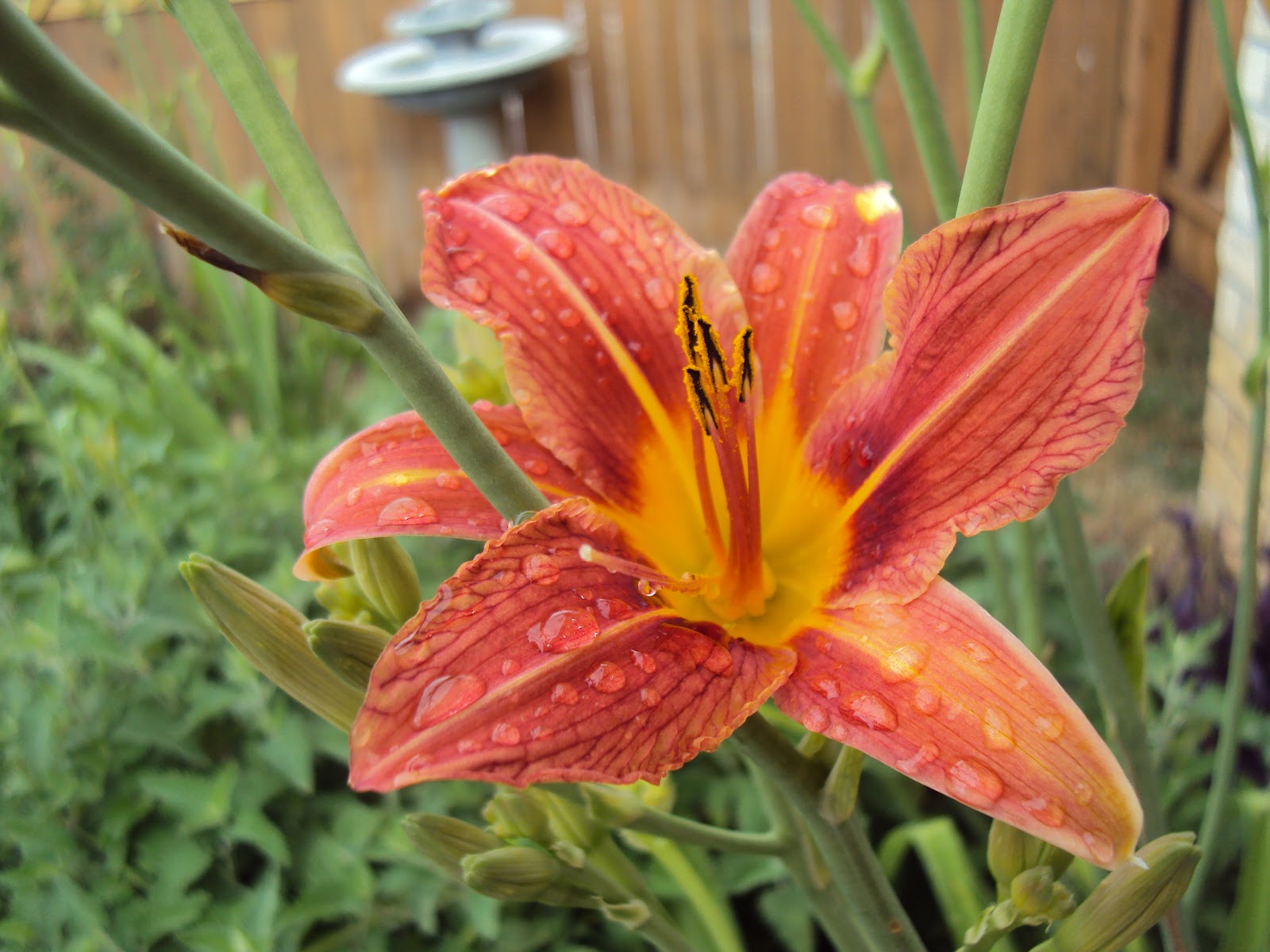
The Ditch Lily, the tallest of my daylilies, is the first to bloom this year. The middle of last month I was noticing that all the daylilies were going into stress and showing signs of dying back but the cloudy days and gentle rains over the last two weeks seemed to have made a difference. Hoping this keeps up for the next two months as May and June are our raining month.

Visit Tootsie Time to see who else is participating in "Fertilizer Friday" and showing off what's blooming in their gardens.

Wednesday, April 25, 2012

The Veg Bed

For the last three weeks I've been working on creating a raised concrete bed to grow my first vegetables after seeing different examples of these types of raised bed on Pinterest. The spot chosen was a central area along the east fence where everything I've planted over the last three years, even the hollyhocks, struggled to grow. A raised bed seemed the ideal solution. Next year I'll paint the blocks a bright color like green or French blue. The temperature hit 100 degrees today and therefore any type of outdoor painting is a no go.
I have to say that took a lot longer than expected. The concrete blocks were very heavy and had to be carried one by one from the garage through the house out the back door to the other side of the yard. And it took more blocks than I anticipated. And the number of bags of garden soil and planting soil to fill what appeared to be a small bed was even more surprising. However, next year I should only have to top off the bed so that expense won't be much at all. Before pouring in the soil I lined the bottom and sides of the two-tier bed with weed block fabric. For the smaller one-tier bed I just lined the bottom with the fabric.
Planted in slots around this bed are three types of mint (orange, chocolate, and Mojito), two strawberries, a sad looking nastursium that doesn't seem able to stand upright, Texas terragon, cilantro, English and Provence Lavender, a grape tomato, and shallot and garlic bulbs [they're planted in the back in the slots that look empty right now]. Lowe's was having a half price sale of herbs and veggies this past weekend for $1.50 so I kind of went overboard with the plants. The center of this bed has zucchini, squash and bell peppers. Marigolds, one of the plants I have always killed, was tucked in to help ward off bugs. The veggies and herbs I have high hopes for. The marigolds I have no doubt I'll kill within three weeks, which is my record for how long I can keep this particular plant alive.
In the lower bed, I have onions, the remainder of the garlic bulbs, and three strawberries planted in the outer slots. The central bed has two types of cucumbers and blue lobelia [for some color until the cucs grow up the trellis].  As a first time veg grower I think I made an amateur mistake. When I described what I was growing my co-worker pointed out that some veggies cross pollinate. So I may have some very onion-y tasting cucumbers before the summer is out. Oh well. Live and learn.
My luck with seeds has improved this year. The chammomile I planted last year came up and is blooming. The cheerful little white flowers look great next to the dill, and little seedlings of the cilantro I planted at the end of March are poking up from the soil too. Yay!
And lastly, the Zebrina Mallow seeds I planted in the fall of 2010 made it through the severe drought of last year thanks to much nursing from me to FINALLY bloom this year. It's not quite as tall as I was expecting but the lovely striped flowers make up for its stature. Now if we could only get more rain. The stage 2 water restrictions are a royal pain. We can only water 1 day a week 1 time. Handwater is allowed anytime but with a garden like mine it takes an hour just to do the backyard. Course, it's rather relaxing to walk around and slowly handwater the beds and inspect everything.

Saturday, March 24, 2012

Do or Do Not - You Can Always Try

I have discovered over the years that many gardening rules can be broken... or at least you try. It might cost you a plant or a few plants but one of the appealing parts of gardening is that it's a living palette and you, as the artist, can move the plants around as much as you like.

I often read that you are only supposed to transplant plants at certain times. Well, I've moved irises around in the spring, summer and fall. And when I bought my first [and so far only] home five years ago, I dug up every bulb I could in my rental cottage to take with me. And boy am I glad I did. The four feet tall magenta asiatic lilies bloomed that summer and I have never found these again in the big box stores. I also haunt the clearance racks of Lowe's regular and have gotten such great deals that I didn't care what month it was when I had to plant it. For example, I got a lovely white rose standard for 75% off at the end of last october and planted it immediately afterwards... and it's doing just fine as the central focal point in the center bed. Can't wait to see it bloom for the first time this spring!

Pictured below: Transplanted lilies and larkspur. All doing just fine in their new homes. Got dirt? Will fill!
If you don't succeed, try, try again.... this circular bed dug two years ago was supposed to be a herb circle. Well, I learned that first year that I can kill more herbs than I can grow. So year two daylilies, gaillardia, and shasta daisies were inserted into the bed along with the parsley, dill and cilantro - the herbs I did succeed in growing. Now it's just the circle bed and this year the dill and parsley are already coming back in full force. The cilantro I've had to reseed. And a beautiful rose bush that I scored for $2.50 from Lowe's along with that rose standard mentioned above made it through winter just fine. Course, we really had a mild winter so I probably just got lucky with this one. 
That plant I saw and wanted... then couldn't find. My co-worker bought a new house right before me and I discovered what looked like striped miniature hollyhocks in her backyard. Before I could make it back over to dig it up - since they were cleaning out this overgrown bed - her hubby had run over it with the mower. No more plant, wah! Two years later I found it at a local nursery and eagerly bought it and planted it along the back fence. This was a pricy plant for me, though I'm sure most folks would find the price reasonable. Anyway, it died by winter, 5 months later. Then I discovered that the nursery on the Texas Tech campus had this plant - the Zebrina mallow - growing in their strolling beds and collected a few seeds. Got nada. In case you're wondering why I didn't order the plant from a nursery the reason is simple - I kill over 50% of all plants I've ever ordered. The odds are just not in my favor. So I try to buy my plants from local nurseries and big box stores, which I know get a bad rap but for a gardener with a small wallet they really are great options for plant buying.

Finally find the mallow seeds at Sutherlands's two falls ago. Plants came up last spring but died down almost to the ground due to the drought. But this year might be my lucky year. Several healthy little plants are growing and I am excited to finally get some purple striped blossoms this summer. Some plants are worth the wait. [I am wondering when they'll finally get taller though. The seed packet said they'd get 3-4 feet tall. So far not even breaking 1 foot.]
Ever wonder why when you scatter seeds that nothing ever comes up or your plants don't reseed like they're supposed to? Maybe it's because you're using mulch. For three years I regularly mulched my beds to keep them clean looking and to keep down the weeds. Last year I didn't get around to it fast enough and bingo! suddenly I have tons of baby plants coming up in the fall and early spring. Pictured below are about 1/3 of the tall coreopsis plants that have reseeded themselves from last fall.

No more heavy mulching of the beds for me! I want my freebies for next year's garden. And I've discovered some plants reseed themselved several feet from their mother plants. For instance, today I dug up 5 purple salvias, 1 maroon scabiosa, and 1 gaillardia babies from the grass walkways and transplanted them into the various flower beds. The salvias particularly are really good about putting out offshoots or babies. More free plants, wahoo!
And sometimes the plant just win. I have tried to dig up this large hollyhock for two summers. The tap root is so deep I can't get it out. So I've decided to just let it flower this year and then try killing it again... and dig out all the reseeded plugs that will obviously result. Meanwhile I guess I'll need to transplant the two pincushion plants being overshadowed by this monster. Seriously, this thing is 3 feet x 3 feet, the widest hollyhock I've grown so far. This is growing around the small patio and this variety of hollyhock has reseeded itself around three sides of the patrio. The seeds get between the concrete and the grass and the tap roots are impossible to pull out. So I'll just go with the flow and enjoy the flowers in the summer... while I quietly plot it's death in the fall.
A few other quips of gardening wisdom. Bermuda grass is evil and always will be. It is next to impossible to remove when I'm creating a new flower bed and then sneaks back in before the season is out. Like coachroaches, you cannot truly kill Bermuda unless you pave over it. So I just have to continue to curse it regularly as I putter around in the beds.

True gardeners are plant collectors. We can't help it. We have to have as much as we can cram in the ground. Got a bare spot to fill? I'll cram a daylily, rose or salvia in it as soon as possible. Course, it will probably involve shoving the garden cat, Penny the Pill, out of the way as I'm doing it because as far as she's concerned a bare spot is grounds for rolling in the dirt... before she waddles over to roll on top of my plants. A fluffy bed of larkspur? Penny finds it to be a very comfortable place for a nap. Funnily enough, she can't stand the catnip which is running amuck in three of my beds. I only planted it in one!

And if you see a plant with the words "The plant you can't kill" written on it just spit on it and keep walking. It's only teasing you. For example, I've killed marigolds more times than I care to admit. I simply cannot grow this plant. And yes, the stupid plants did have that written across the pot. The only reason I want to grow it is that it reminds me of my late granny. She had a green thumb like nobody's business. I've inherited my semi-green thumb from her. So each spring I buy a marigold and hope that this is the year I can get granny's signature plant to grow... but deep down I know I'm going to kill it within 7 weeks. I guess I'm an ever hopefuly optimistic pessimist?

 And last, but not least, you should always wear either sunscreen or a hat while working in the spring/summer garden. A rule I'm constantly guilty of not doing. Yesterday it reached 82 degrees with a soft breeze. It didn't feel hot enough to get a sunburn but my lobster reflection in the mirror says otherwise. I so need some shade in the backyard! Even Penny wanted inside to take her afternoon nap.

Saturday, May 22, 2010

Score!

About two years ago I noticed a plant the backyard of my friend's new home. It looked like a striped minature hollyhock and the leaves of the plant also looked similar to a hollyhock. But no one seemed to know what it was and I couldn't find anything like it in my numerous gardening magazines or books. I went back to my friend's to collect a few seeds only to find out her hubby had cleaned out that whole bed, which had become overgrown. Some time later I saw this very plant in one of the gardening catalogs that came in the mail. It was a Zebra Mallow.

However, I have only had a 50/50 percent success rate with plants ordered through the mail. In fact, the bulbs I've bought from Sam's have proved to be larger and hardier than the ones ordered in the mail. Others must have discovered this since Sam's was wiped out of the large gladiolas very earlier on. There were none left when I stopped by. Good thing the ones I planted last year have survived and are coming up everywhere. But I digress as usual...

Last fall I discovered my school's greenhouse garden had a Zebra Mallow and I collected a few seeds, careful not to harm the plant in any way. The garden is a teaching garden and just a nice place to stroll to see what's blooming during the season. I planted the seeds this spring and got... nothing. They were kind of sad looking seeds but I was hoping for at least one seedling to come up. Then last weekend I visited a local nursery and there it was, tucked inconspicously between Stella D'Or daylilies and mixed verbenas. I was so thrilled I didn't even mind paying a bit more than I usually do for a plant. Since it's a perennial, it's totally worth the cost. And if it does well then perhaps its seeds will put out new ones next year. The pot label said it will grow up to 36" high with 2 1/2" spires and hardy to zone 2.

The Zebra got planted this morning, along with several new purchases. I managed to expanded a small part of the side bed before having to call it a day at around 12:30. It was miserably hot already, so it shouldn't have surprised me late this afternoon that the temperature had reached 100 degrees [according to one bank I drove past]. 

Edited post on 5/28:  When I went to check on the plant this morning I discovered that it had two different flowers blooming. Some of the flowers have a white background with the stripe while others are purple background with the stripe. Very cool!

In order to make room for some of these plants, I had to move others around. A few irises got moved, along with some small daylilies. Planted were 20 new purple and white asian lilies, two Margarite daisies [who have such nice scents when you rub on them] and my other great plant score - a "Goodness Grows" Veronica.  I have two other varieties of Veronicas and they are such good plants. Beautiful spires on hardy, strong stems. Again, I found this plant hidden among piles of other potted plants and immedately recognized the flower. And the best part was that I only paid $3 for it at Walmart. Usually Veronicas run between $6-7 a pot. Granted, this pot was about half the size what I normally see (1 gallon) but it'll grow and spread within a season. Still have one other to plant but need to expand the bed some more to plant it. The purple spires will contrast nicely next to the pink spires.

LinkWithin

Related Posts with Thumbnails